

We migrated to Australia from Holland when I was 12 years old and my first look at Melbourne was from the deck of the migrant ship ‘Sibajak’, just before we docked at Port Melbourne. The skyline of the city was nowhere near as imposing as it is today and at first sight I couldn’t say that I was over-impressed.
It was the 15th June 1955 and as I looked down onto Station Pier I noticed the old ‘Red Rattler’ train sitting there waiting to take us to Spencer Street. We disembarked, a short trip into Melbourne, a quick look around the city and we were bundled on the the overnight train which was to take us to Albury, then to Bonegilla, a migrant camp near Wodonga.
We had our evening meal on the express train and I had my first (and only) taste of a four ‘n twenty meat pie and found it inedible, although they have probably improved the quality since then.
Bonegilla was an old army camp from World War II and had been in disuse (and disrepair) ever since then. It had been spruced up in a fashion for the thousands of incoming migrants.
It was to be my first experience with multi-culturalism. People from all over Europe, from countries like Holland, Italy, Greece, Yugoslavia, Hungary and Malta, etc, were all thrown together in an area that covered only about one square kilometre. There were a few larger barracks which were used for a picture theatre, a general store and a mess hall. There was even a hospital and a resident doctor.
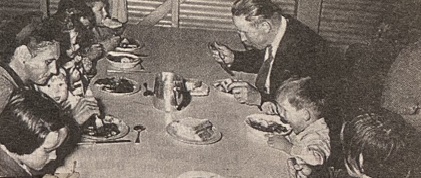
I’m not wanting to sound like a whinging migrant (we never complained) but the conditions in the camp by today’s standards were absolutely appalling. They made a Japanese prison camp look like a beach resort.
The huts were made of fibro cement, and in June and July (mid-winter) we nearly froze to death under our wafer thin army blankets. The latrine stank, sanitation was non-existent and many people, including myself, suffered from gastro-enteritis.
During our stay there we hitch-hiked the ten kilometers into Wondong a few times and the only decent food we had for the next ten weeks was the food we got from the supermarket.
Despite all that I will always fondly remember the two and half months we spent at Bonegilla (you always tend to remember the better parts later) and a few years ago, Marg and I, on our way to the Kosciuszko National Park, took a little side trip to the old site at Bonegilla.
There are brand new army barracks there now and the Kosovo refugees certainly experienced a lot better conditions that we endured in 1955. The pleasant side of our stay at the camp was the beautiful countryside around the Albury-Wodonga area.
We hiked all over the place and the view of the Hume Weir from the nearby hills were quite breathtaking. It introduced me to bushwalking which we still do till this day.
Many of the migrants found work in Wodonga, Albury and Tallangatta and I’m sure some of them and their descendents are still living in the area. We became friends with quite a few of the other internationals and I remember an Italian bloke who I met again a few years later at the Box Hill railway station where I sold papers for about three years. He always bought the Hearld off me and gave a generous tip.
Some of the friends we kept in touch with for a while moved to Cooma and finished up working on the Snowy Mountain scheme in the 1960’s and 70’s.
I played soccer for Ringwood City during my late teens and I met quite a few of the younger guys I knew at the camp and was pleased to catch up with a few of them again. We’d have a few beers after the game and a good laugh about our days at Bonegilla.